Executive SummaryTell me if you've heard this one before: a new technically brilliant diagnostic tool is on the edge of paradigm-shifting change, it opens new doors for researchers, it might even gain FDA approval, and yet it fails to reach clinical adoption and benefit patients. I don't think this is a new problem, but diving into spatial biology recently, I was struck by how it has striking similarities to the patterns I watched play out with circulating tumor cells over more than a decade. This report synthesizes expert interviews with product managers, pathology workflow specialists, and diagnostic developers to explore why; written from a product strategy perspective, for the people responsible for turning promising technologies into products that actually reach patients. The core finding: Success isn't blocked by technology-specific problems. Both CTCs and spatial biology are caught in a paradigm shift from visual, pathologist-driven diagnosis to digital, computational pathology. A three-way disconnect emerges between what developers build (comprehensive profiling tools), what pathologists say they want at conferences (rich spatial data), and what clinical workflows actually demand (simple answers under productivity pressure). The contrast is instructive. Cell-free DNA liquid biopsy achieved clinical adoption where CTCs didn't—not because cfDNA is technically superior, but because companies like Foundation Medicine and Natera matched their business models to adoption realities: central labs, bounded clinical questions, deliberate evidence generation, and workflow compatibility with what was already in place. This paper maps the barriers, proposes a framework for understanding them, and offers a playbook: from timeline planning and evidence phasing to business model selection. Key Insights
Section 01 — Introduction
The Precision Diagnostics Paradox1.1 The Technologies at a GlanceBefore I dive into adoption dynamics, I think it's important to share some detail about the technologies I am using to frame this conversation. My goal in describing these technologies is not to give an exhaustive technical deep dive, but rather to set up the lens through which I'll examine adoption barriers. Cellular Liquid Biopsy: Circulating Tumor CellsCirculating tumor cells are rare cells shed from primary tumors or metastatic sites into the bloodstream1,2. The technical challenge is staggering: a typical 7.5mL blood draw contains billions of normal blood cells and, in a cancer patient, perhaps 1 to 100 CTCs. Finding them is the proverbial needle in a haystack, except the needle looks almost like the hay. CTC technologies aim to capture (sometimes live) intact cells for downstream analysis via many different analytical methods. The clinical promise is real: CTCs offer a less invasive window into metastatic biology that other approaches can't match. Clinical adoption is slow, with technologies failing to get traction and payers lacking enthusiasm for the added value. Spatial BiologySpatial biology technologies analyze tissue samples—typically thin sections from biopsies or resections—while preserving the spatial relationships between cells3. Where traditional pathology tells you what cells are present and bulk molecular methods tell you which genes are expressed, spatial biology tells you where everything sits relative to everything else. Key permutations include multiplexed protein or RNA detection at single-cell resolution, spatial relationship mapping, and tissue architecture preservation—integrating molecular and spatial data in ways that neither histopathology nor sequencing can achieve alone. The yet-unrealized clinical potential centers on biomarker discovery, patient stratification, immunotherapy response prediction, and tumor microenvironment characterization. How These Technologies Relate to What's Already WorkingBoth technologies complement rather than replace traditional tissue biopsy and pathology. CTCs offer a liquid sampling approach for monitoring and for situations where tissue biopsy is difficult or risky. Spatial biology enhances tissue analysis by adding molecular resolution to traditional histopathology—it makes the pathologist's existing sample more informative rather than requiring a new sample type. Compare that to cfDNA—fragments of DNA shed into the bloodstream from dead and dying cells—which has achieved clinical adoption. At the same time, cfDNA has a fundamental limitation: because it comes from dead cells, it provides genomic information but limited insight into viable tumor populations or real-time tumor heterogeneity37. CTCs represent living cells from active tumor populations. The technologies are genuinely complementary, but cfDNA succeeded clinically where CTCs didn't—primarily because cfDNA leveraged existing PCR and sequencing infrastructure rather than requiring entirely new workflows. These relationships matter because they illustrate a pattern this paper returns to repeatedly: technologies don't fail because they lack clinical value. They fail because they can't find a viable path into existing workflows, demonstrate that value within the constraints of reimbursement systems, or both. Table 1
Representative Spatial Biology, Cellular Liquid Biopsy, and Cell-Free Liquid Biopsy Technologies
1.2 Why These Technologies? A Personal PerspectiveCTCs and spatial biology seem like an odd pairing for comparison. One analyzes blood samples for epithelial and mesenchymal cells in circulation. The other analyzes tissue sections for spatial protein or RNA patterns. The two methodologies represent different biological substrates, analytical endpoints, and potentially different customer bases. However, they share something fundamental: both technologies deliver pathologist-relevant cell information through digital/molecular methods that disrupt decades of visual pattern recognition training. I spent twelve years at ANGLE plc, where I was employee number three. We took the Parsortix circulating tumor cell platform from proof-of-principle through technical development, clinical validation, FDA De Novo clearance, and commercial launch. It was exhilarating work: solving genuinely hard technical problems, seeing the platform perform in customer hands, celebrating regulatory milestones. When I was at ANGLE, we positioned CTCs as complementary to tissue biopsy (liquid monitoring versus solid diagnosis). But my experience working on sales enablement told a different story. Both RUO and clinical customers wanted assays tied to clinically actionable biomarkers, not complementary information about cells in circulation. Simply knowing the patient had a high number of CTCs based on epithelial or mesenchymal markers alone did not help with therapy selection. In practice, we competed with cell-free DNA liquid biopsy, which achieved clinical adoption where CTCs struggled4,5. Understanding why reveals the pattern I kept seeing with spatial biology. cfDNA focused on biomarkers as a means of characterization. Some approaches used deep sequencing, others cast a wider net across gene panels, but the common thread was clinically actionable information delivered with instrumentation already in laboratories. The objection I heard most often about CTCs—related to assay value in relation to cost of instrumentation—is almost word-for-word what spatial biology companies hear today about their instrumentation. The technologies provide useful research context and in some cases rich biomarker information3. However, the cost and technical complexity of both technologies makes the value proposition harder for researchers and clinicians to buy into. This leads me to spatial biology's core challenge: asking pathologists to move from familiar H&E microscopy toward fluorescent imaging and computational analysis. It's important to note that this isn't about capability; pathologists are highly skilled professionals who absolutely can learn new analytical approaches. It's about the transition costs when you're already operating under intense productivity pressure6. 1.3 Learning Through ConversationsBetween November 2025 and January 2026, I conducted expert interviews with individuals working on spatial biology product management, liquid biopsy commercialization, and pathology workflow integration. I spoke with people at established spatial biology companies, liquid biopsy leaders, and individuals with deep pathology experience. To protect competitive intelligence and encourage candid discussion, I'm synthesizing insights without attribution to specific individuals or companies. I'm not an objective outside analyst. I bring more than a decade of lessons learned from trying to commercialize in the precision diagnostics world. That experience shapes how I interpret what I'm hearing, but I think it also allows me to recognize patterns that someone without implementation experience might miss. 1.4 The Central HypothesisThrough my conversations and research, I've developed what I'm calling the three-way disconnect model for precision diagnostic adoption: What developers build: Comprehensive profiling platforms showcasing technical sophistication—more targets, more data, more complexity.
What pathologists say they want: At conferences, genuine enthusiasm for spatial relationships, tumor heterogeneity, "the next layer of information."
What clinical workflows demand: Simple, actionable answers delivered efficiently. As one product manager said: "Pathologists want the minimum required to answer the clinical question."
All three perspectives are simultaneously true. But they point in different directions. That creates the adoption barrier. 1.5 Stakes and ImplicationsWhy does this matter? For diagnostic companies: Development costs easily run to tens of millions. Building toward paradigm shift without acknowledging timeline implications wastes that capital. For pathology labs: Equipment decisions have long-term consequences. Labs that invest in technologies mismatched to their workflows end up with expensive equipment collecting dust. For patients: Precision diagnostics promise better treatment selection and earlier intervention. But those benefits only materialize if technologies actually reach clinical use. I've seen technically brilliant work fail to impact patient care because of commercialization mismatches. That bothers me. And I think the diagnostics industry can do better if we're more honest about the distinction between incremental innovations and paradigm-shift technologies. Section 02 — The Core Problem
The Three-Way Disconnect2.1 The Model: Three Competing RealitiesWe see a three-way disconnect in diagnostics. Developers optimize for technical capability and market reception. Pathologists articulate interest in comprehensive data when thinking abstractly. Clinical workflows optimize for productivity under time constraints. 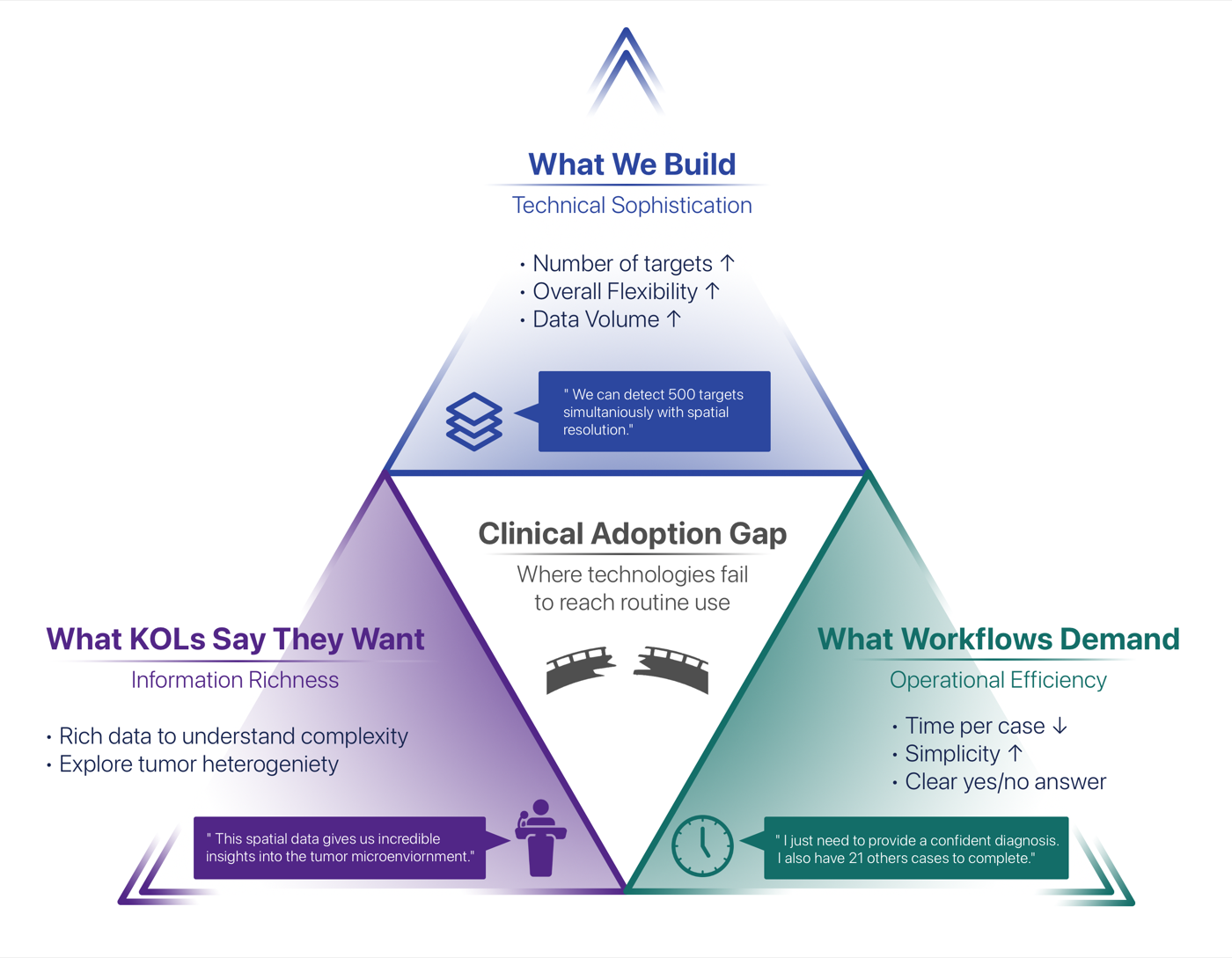
The disconnect isn't a communication failure; it's a structural misalignment of incentives and constraints. 2.2 What Developers Build: The Comprehensive Profiling TrajectoryI understand the developer mindset intimately because I've built my career on it for more than a decade. When you're building a precision diagnostic, the technical problems are genuinely hard and genuinely interesting. How do you capture rare cells from blood with high purity and viability? How do you image tissue at single-cell resolution while preserving spatial context? How do you increase multiplexing capacity without sacrificing signal quality? We get stuck leveling up through a series of worthwhile challenges. Solving them requires sophisticated engineering, careful validation, iterative optimization. Maybe you've achieved 8-plex imaging; now can you do 16-plex? You've automated sample processing; now can you reduce hands-on time further? You've demonstrated proof-of-principle; now can you scale throughput? The trajectory is always toward more sophistication. One spatial biology product manager described the reality: "It's not just the assay on the device and the pathologist. It's the assay on the stainer that goes into the scanner, into an analysis pipeline, into a platform front end." Each component serves a function, but from the customer's perspective, they're buying an answer to a clinical question. Every additional component creates potential friction. Research markets reward comprehensive profiling, but optimizing for research adoption often creates technologies poorly suited for clinical workflows. So perhaps the answer is to make it simpler? In my last role, we focused on radical simplicity. Our platform captured and concentrated rare cells, then provided those cells for whatever downstream analysis the customer wanted. We thought this flexibility was a strength—do gene expression, genomic analysis, proteomics, whatever you need8,9. I remember one particular interaction where I realized that this optionality was overwhelming. The lab was interested in our capabilities, but they didn't want to develop their own downstream assay. They wanted us to hand them a protocol. That interaction stuck with me because it captured a pattern I saw repeatedly. Unlimited downstream options created too many permutations. Rather than simplifying the customer's decision, we (technology developers) made their world more complex. The lesson I learned was that neither simplicity nor sophistication matters if the end-to-end workflow does not meet the needs of the intended customer. The open-ended complexity became a barrier rather than an advantage. Rather than focusing on the largest feature set, or making something simple and flexible, it is always best to think about the customer and their workflow. 2.3 What Pathologists Say vs. Do: The Enthusiasm GapHere's what confused me for years: pathologists would express genuine interest in new technologies at conferences, then not adopt them in their labs. A product manager who attended AMP 2025 came back surprised: "Pathologists want the simplest tool that allows them to answer the clinical question. They don't really want to have more information. What they want to have is the minimum required." But at that same conference, there were presentations about spatial transcriptomics, discussions about tumor microenvironment analysis, enthusiasm about the "next layer of information" beyond traditional pathology. So which is it—do pathologists want rich spatial data or minimal information? Both. It depends on the context. When pathologists are thinking abstractly about future possibilities, spatial data is genuinely compelling. Understanding cell-cell interactions, mapping immune infiltration, characterizing tumor heterogeneity; these are scientifically interesting questions that could plausibly inform treatment decisions. But when the same pathologist is back in their lab on Tuesday morning with forty cases to review, the equation changes. They're not thinking about what's scientifically interesting. They're thinking: Can I make a confident call on this case before lunch? Do I need a second opinion? Is there anything unusual that requires additional workup? Economists have a term for this: revealed preference10. What people actually do reveals their true priorities more accurately than what they say. The concept has particular relevance in diagnostic adoption, where conference enthusiasm rarely predicts clinical purchasing decisions. One expert gave me a perfect example: targeted NGS panels have achieved clinical adoption despite 2–3 week turnaround times. Why? Because the information is bounded (200–500 genes, not whole genome), actionable (these are drug-targetable alterations), and the workflow is compatible with existing molecular pathology lab processes11,12. Pathologists accepted the turnaround time because the value proposition was clear and they didn't have to change fundamental aspects of their practice. 2.4 What Clinical Workflows Demand: Simple Answers Under Productivity PressureOne conversation in particular crystallized this for me. I was talking with someone about pathology workflow barriers, and they mentioned something I'd never fully appreciated: productivity pressure measured in cases per hour as opposed to more generally considering throughput. In a clinical pathology lab, there's a relatively fixed amount of time available and a somewhat unpredictable volume of incoming cases. Labs optimize for throughput while maintaining diagnostic accuracy6. That creates intense pressure to keep workflows moving efficiently. Now imagine you're a pathologist who has spent decades developing visual pattern recognition for H&E and chromogenic IHC13,14. You can look at a slide and rapidly assess: normal vs. abnormal, inflammatory vs. neoplastic, grade and stage. This expertise is hard-won and deeply valuable. Then an up-and-coming company comes along and says: "We have this new technology that will give you more information: single-cell resolution, spatial context, 16 biomarkers simultaneously. But you'll need to learn fluorescence interpretation, and the analysis happens computationally, and you'll need to integrate this into your existing workflow." Even if the technology performs perfectly, you've just asked this pathologist to set aside decades of pattern recognition expertise for a new paradigm with a learning curve15. And they need to do this while maintaining their current case volume. The reality is that new diagnostic approaches aren't asking to integrate seamlessly into existing workflows. They're offering complementary bolt-on capabilities that could be thought of as research-grade answers that come with inherently more complexity than traditional methods. This isn't necessarily bad, but it means the adoption path runs through proving that the additional complexity delivers value worth the disruption. Someone with decades of experience in diagnostic technology commercialization put it bluntly: "The moment where the technology requires changing aspects of the workflow, upstream and downstream, it will create the biggest obstacles." This is why data presentation matters so much. Multiple people I spoke with emphasized that clinicians want clear, interpretable results with minimal cognitive load. One person said: "They just want to know what the answer is. The less time they have to think about it, the happier they are." This isn't about intellectual capacity. Pathologists are brilliant diagnosticians. It's about the realities of clinical practice under time pressure. 2.5 The Paradigm Shift: Why CTCs and Spatial Biology Face Identical BarriersSo why do I keep saying CTCs and spatial biology face the same challenges when they're such different technologies? Because they both ask pathologists to move from analog visual diagnosis to digital computational analysis, and they both represent paradigm shifts that disrupt decades of established practice. To understand this, it helps to remember the traditional role pathologists play in oncology diagnosis. For decades, tissue biopsy has been the gold standard16. A pathologist receives a tissue sample, prepares slides, examines cellular architecture and morphology under a microscope, and makes a diagnostic call. This workflow is deeply embedded in clinical practice and in pathologist training. The Liquid Biopsy Paradigm ShiftWith liquid biopsy approaches like CTCs, the diagnostics world is offering a fundamentally different sample type—blood rather than tissue. This sample type is inherently more complex for analysis because circulating tumor cells are rare, heterogeneous, and require characterization to provide actionable information. I remember working with a pathologist who was new to rare cell analysis. They felt quite confident that they could help simplify the analysis pipeline and discern CTCs from other cells via H&E staining. However, this proved to be challenging because the cells were not surrounded by normal tissue and so it was difficult to be confident in distinguishing tumor cells from other large cells without the surrounding tissue architecture they relied on for context. A separate work stream had us developing a systematic process for IF staining of specific biomarkers. In retrospect, we did not put enough focus into clear reporting of results. The promise was clear: richer information about metastatic disease and tumor evolution that tissue biopsy may miss. However, without clear reporting, the information was not accessible to clinicians. Companies like RareCyte have pushed this further, moving beyond simple enumeration to detailed single-cell characterization. That movement beyond enumeration represents the recognition that simply counting CTCs provides limited clinical value1,17. You need to characterize what those cells tell you about tumor biology, treatment resistance, metastatic potential. These answers require sophisticated data analysis, presented in a clear and actionable way. The data output is almost its own product. Either you do the interpretation for clinicians, or you ask them to interpret unfamiliar data under time pressure—and the analytical workflow has moved far beyond looking through a microscope. The Spatial Biology Paradigm ShiftWith spatial biology, you're still analyzing tissue samples (maintaining that connection to the traditional pathology workflow), but the output isn't a microscope image. It's computational data about protein expression patterns, cell-cell distances, spatial relationships. You're asking pathologists to interpret quantitative metrics rather than visual patterns. One expert with extensive experience in pathology workflow optimization described the transition as "switching off the light." When you move from chromogenic IHC to immunofluorescence, you remove visual reference points that pathologists use subconsciously. The tissue looks different. Even if the information content is equal or richer, the cognitive load increases because pathologists have decades of pattern recognition training in chromogenic stains15,18. The Common ThreadBoth technologies deliver valuable cell-level information. Both require expensive and specialized equipment not widely present in clinical labs. Both lack established reimbursement pathways. Both struggle with the clinical utility catch-22 (more on this in Section 3). And both ask users to adopt new analytical paradigms that complement but don't replace traditional approaches. The core transition happening across precision diagnostics is moving from visual pattern recognition to computational data analysis15,19. Traditional pathology is fundamentally a visual discipline: you stain tissue, look through a microscope, and assess patterns. Digital pathology and spatial biology ask pathologists to trust computational analysis over visual assessment. Even when images are involved, the analytical workflow depends on software to segment cells, quantify marker expression, calculate spatial relationships20. These aren't insurmountable barriers. But they are real costs that technology developers often underestimate. Recognizing this pattern explains why adoption takes longer than companies expect—and why business strategy must match these realities. It was only during my conversations with spatial biology professionals for this project that I recognized this pattern, and it has reframed my thinking on why past products I have worked on struggled clinically despite strong technical performance. Those technologies were facing the same paradigm-shift barriers that spatial biology faces now. CTCs still provide valuable research insights, but they remain too expensive and the insights too open-ended to have clearly reimbursable clinical value for most patients today. Section 03 — Timeline Reality
The 5-Year Rule and the Timeline Reality GapCore Finding 1
Paradigm-shift technologies require 5+ year timelines from research to clinical adoption—not the 18–24 month cycles of incremental innovations. This reflects what it takes to build trust, generate evidence, and change practice patterns when you're asking users to adopt fundamentally new workflows. The companies that fail will be those that build toward 18-month commercial timelines appropriate for incremental innovations, then find themselves running out of runway when adoption doesn't materialize quickly. 3.1 Evidence: Paradigm Shifts vs. Incremental InnovationsWhy cfDNA liquid biopsy succeeded where CTCs struggledWhen cell-free DNA liquid biopsy emerged for oncology applications, it achieved clinical adoption relatively quickly (though not without challenges)4,21. There are a few sensible explanations: Existing infrastructure. Sequencers were already in clinical molecular pathology labs22. Protocols for DNA extraction and library prep were familiar. The analytical workflow (variant calling from sequencing data) aligned with existing molecular pathology expertise. Clear clinical utility. Here we can draw from the example of minimal residual disease (MRD) monitoring. The value proposition was straightforward—detect recurrence earlier than imaging, enabling earlier treatment intervention23,24. That translates directly to improved outcomes. Reimbursement pathway. Companies like Natera and Guardant Health successfully navigated reimbursement for specific indications25. Signatera gained Medicare coverage for MRD monitoring. That created a sustainable revenue model. Foundation Medicine tells the same story on the combined tissue and liquid side. FoundationOne CDx for tissue genomic profiling, FoundationOne Liquid CDx for plasma ctDNA—both run through a central CAP/CLIA lab, both focused on specific actionable questions, both with reimbursed indications built through deliberate evidence generation. These technologies have something in common. They didn't try to answer everything about the tumor. They answered what oncologists needed to make a decision and built from there. In contrast, CTCs have always required more activation energy to get to market. They required specialized equipment not widely present in clinical labs. The value proposition beyond simple enumeration remained unclear. Reimbursement pathways never materialized. And the question "what do you do with this information?" didn't have a clear answer that changed clinical decisions at scale. Why targeted NGS succeeded despite longer turnaroundSomeone else I spoke with who also attended AMP recalled that it was interesting that pathologists were happy to accept somewhat longer 2–3 week turnaround times for targeted NGS. While it might take longer to a result, the information is bounded, actionable, and the workflow is compatible with existing molecular pathology processes. Targeted NGS panels (200–500 genes) focus on drug-targetable alterations. The test answers a specific question: does this tumor have mutations that predict response to available therapies? That's immediately actionable for oncologists. And molecular pathology labs already had sequencing workflows. Targeted NGS was an extension, not a revolution. Spatial biology, in contrast, often generates data that doesn't have clear clinical action items yet. Yes, understanding tumor microenvironment should matter. But "should matter" doesn't inform "here's what I do differently tomorrow based on this information." The 5-year timeline for paradigm shiftsAn interviewee described the realistic timeline from academic research to clinical adoption: "From academic researchers [getting started to] ASCO results, you're probably talking about a five-year project." The example they gave illustrates the companion diagnostic pathway specifically, though other pathways exist. For CDx development, the timeline typically looks like: Years 1–2 Build translational evidence in pharma discovery groups, demonstrating that your technology generates data relevant to their programs. Years 3–4 Get incorporated into clinical trial designs, where you're generating prospective evidence about biomarker-outcome relationships. Year 5+ Demonstrate clinical validity (biomarker predicts outcome) and clinical utility (testing changes decisions and improves outcomes). One person I spoke with familiar with pharma partnerships shared the stark reality: "You've got to play the odds that hey, we're willing to spend 10 times the amount up front to get the one that works… because for the most part, 1 in 10 drugs actually gets out of the clinical trials effective." That means most companion diagnostic partnerships (even with enthusiastic pharma champions) end up "on the cutting room floor" when the drug fails26. This is why building clinical adoption solely on the back of CDx partnerships is risky. You need multiple pathways. The 5-year timeline reflects this fundamental reality: you must prove research utility, build clinical evidence, then achieve adoption—in that order. Companies that assume 18-month timelines appropriate for incremental innovations end up burning through capital, disappointing investors, and creating unrealistic pressure on development teams. 3.2 The Clinical Utility Catch-22: Definition and MechanismClinical adoption is the finish line every diagnostics company is trying to reach. But here's the fundamental problem every paradigm-shift diagnostic faces in getting there: 01You can't achieve clinical adoption without demonstrated clinical utility.
02You can't demonstrate clinical utility without people using your test.
03You can't get people to use your test without clinical adoption.
04You can't afford to demonstrate utility at scale without the revenue from adoption.
This is what I call the clinical utility catch-22, and it's the single biggest barrier to paradigm-shift diagnostic adoption. The Finish Line
Clinical Adoption
Payers reimburse, physicians order, patients access
Who demand…
Generate Revenue
Customers
↓ Cost · ↑ Revenue
funds more evidence Can't attain without…
The Catch-22
Which requires…
The Evidence
Demonstrated Clinical Utility
Testing changes decisions and improves outcomes
Relies on…
The Funding
Affordable to Demonstrate
Revenue funds the prospective studies
I'd like to spend a few moments on each of these components because this is an important problem to understand. Can't achieve adoption without utility: Clinical adoption requires that payers reimburse, physicians order, and patients access your test. Payers won't reimburse without clinical utility evidence. Hospitals won't invest in expensive equipment without reimbursement. Physicians won't order tests that patients can't afford. Clinical practice guidelines won't recommend tests without strong evidence. Can't demonstrate utility without usage: Clinical utility means "testing changes treatment decisions and improves patient outcomes." You can't prove this without prospective clinical studies showing that physicians who have test results make different (and better) decisions than those who don't. But you can't run those studies if no one is using your test. Can't get usage without adoption: Here there is actually another circular trap. You need people using your test to generate evidence, but you need evidence to drive usage. Can't afford demonstration without revenue: Demonstrating clinical utility requires running expensive prospective studies. But if you're early-stage with limited customers, you don't have the revenue to fund these studies. You need customers to generate revenue to afford the studies to get more customers. Gene therapy illustrates the contrast. Despite enormous per-treatment costs, gene therapies achieved clinical adoption because a single intervention could prevent progressive blindness or treat previously fatal spinal muscular atrophy27,28,29; dramatic, visible benefits that justify expensive demonstration studies even at small patient numbers. Diagnostics face a fundamentally different equation30. Better treatment selection or earlier detection matters in aggregate but is harder to demonstrate in small studies and harder to justify at high price points. That's why the catch-22 binds diagnostics more tightly. 3.3 Implications for Strategic PlanningEach of these implications follows from accepting the 5+ year reality rather than hoping for shorter cycles:
Companies that accept these realities survive. Those hoping for 18-month timelines, when they are trying to shift paradigms, do not. Section 04 — Adoption Drivers
Beyond Technical Sophistication to Adoption DriversCore Finding 2
Once technology clears performance thresholds, adoption depends on: workflow integration minimizing disruption and simplified instrumentation answering specific questions before expanding. Technical sophistication matters, but operational fit wins adoption. 4.1 Workflow Integration: The Primary BarrierOne of my conversations revealed an insight I've been thinking about ever since: "Primarily it is workflow integration and actual clinical benefit. The moment where the technology requires to change aspects of the workflow, upstream and downstream, it will create the biggest obstacles." Not cost. Not reimbursement. Not technical performance. Workflow integration. This expert continued: "The cost linked to reimbursement is probably second as, if the technology is powerful enough or brings a unique benefit to an unmet need, there is always a way to make it happen." Less experienced teams often assume cost is the primary barrier: if we could just make the technology cheaper, adoption would follow. But cost is downstream of workflow integration. If a technology disrupts productivity, labs won't adopt it regardless of cost. If it integrates well, they'll find budget. The digitalization barrierIn countries where healthcare systems face short-term financial pressure, labs resist digitalization despite long-term benefits. Why? Scanning time per slide initially exceeds microscope viewing time, so productivity metrics look worse31, even though downstream benefits (easier second opinions, digital archival, computational tools) are significant32. Productivity pressure forces short-term optimization. Innovation-Friendly
Moderate
High
Severe Constraints
Lower financial pressureHigher financial pressure
Switzerland Singapore Nordic Countries Netherlands
France Austria Canada
United States despite high spend Germany United Kingdom Japan
Italy Spain Eastern Europe
The pathologist resistance challenge"The second aspect relates to the majority of the pathologists themselves. They are well-trained on existing methods and due to productivity pressure rely on their experience in an environment they know." This isn't about capability or willingness to learn. It's about the impossibility of maintaining current throughput while adopting new paradigms. It is not realistic to handle the existing case load AND learn fluorescence interpretation AND integrate computational analysis tools. Pathologists have decades of pattern recognition training in chromogenic stains. Those patterns (the ways nuclei look, what constitutes normal versus abnormal) are deeply ingrained. Fluorescence imaging removes those reference points. Even if the information content is equal or richer, the interpretation feels more challenging. 4.2 Simplified Instrumentation: Specific Questions FirstDevelopers showcase multiplex capabilities and comprehensive profiling. But pathologists want simpler: "If this tumor is expressing three of these five markers, it's positive." Building sophisticated platforms makes sense for research. But for clinical use, that sophistication becomes problematic: like using a Formula 1 car for a daily commute. The engineering is extraordinary, but you don't need 1,000 horsepower to get to the office, and the maintenance schedule will bankrupt you. Clinical pathology has a similar dynamic: the question isn't whether your platform can deliver n-plex analysis, it's whether the clinical question requires it. This also mimics how targeted NGS gained adoption. Early panels focused on small numbers of actionable genes. As labs became comfortable with the workflow and physicians understood how to use the information, panels expanded to hundreds of genes11,33. 4.3 Implications for Product DevelopmentBased on these findings:
The companies that succeed will be those that focus on workflow integration and strategic evidence generation over technical complexity. The ones that fail will be those that keep building more impressive capabilities while wondering why no one adopts them. Section 05 — Business Models
The Business Model TrapCore Finding 3
Paradigm-shift technologies need to be affordable and structured appropriately. Distributed-kit strategies appropriate for incremental innovations fail for paradigm-shift technologies. Success requires matching business models to adoption realities: translational research, early pharma partnerships, or LDT service models—each with different timelines, costs, and evidence requirements. 5.1 Why Distributed-Kit Strategies Fail for Paradigm-Shift TechnologiesThe distributed-kit model assumes labs want equipment, will train staff, integrate workflows, and maintain productivity—assumptions that hold for incremental innovations but break for paradigm shifts. Labs resist equipment that disrupts productivity: Expensive instrumentation that requires new expertise, extends turnaround times during the learning curve, and delivers information without clear clinical action items represents risk, not opportunity. The capital-equipment-without-proven-ROI problem: Labs need to justify capital expenditures based on expected utilization and revenue. But utilization projections depend on test volume, which depends on physician ordering, which depends on demonstrated utility, which depends on accumulated evidence34,35. You're asking labs to invest before the value proposition is proven. Hidden costs multiply: Service contracts (commonly between 5–10% annually above the cost of the instrument), specialized training, workflow redesign, quality control protocols, regulatory compliance, potential productivity losses during implementation. These costs often exceed the instrument purchase price over 3–5 years and all factor into total cost of ownership36. 5.2 Three Viable Alternative Business ModelsA
Translational Research ModelThis approach focuses on building robust evidence through academic partnerships and pharma discovery collaborations before pursuing clinical adoption. You're essentially delaying commercialization to build the evidence base that will eventually support clinical utility claims. Timeline 5–7 years before expecting clinical revenue
Revenue pattern Grant-funded and pharma-sponsored studies early, eventual CDx or distributed-kit opportunity
Key requirements Strong academic partnerships, sustained funding sources, patience with extended development timelines
Best for Technologies requiring extensive evidence across multiple disease contexts before clinical value is clear
Slow and expensive, requiring someone (NIH, foundations, pharma partners) to fund evidence generation over many years—but it builds the robust foundation that can support later clinical adoption. B
Early Pharma Partnership ModelRather than waiting for clinical trial involvement, this approach targets pharma discovery and translational medicine groups. You're getting into drug development programs before trials begin, building internal champions who trust your data and see the value. Timeline 3–5 years from discovery engagement to potential CDx
Revenue pattern Partnership revenue from discovery work, eventual CDx opportunity as drugs advance
Key requirements Pharma champion development, trust building through reliable data delivery, tolerance for high partnership failure rates
Best for Technologies with clear drug-development applications where biomarker data can inform target validation or patient stratification
The critical insight from one pharma-experienced interviewee: "Clinical trial teams won't trust you right off the bat. You need years of translational work first." But with 1-in-10 drug success, many partnerships "end up on the cutting room floor"—requiring diversification across multiple pharma partners. C
LDT Service ModelRun assays through your own CAP/CLIA-certified laboratory as a service offering. You maintain control over quality, workflow, and data interpretation while building case studies and evidence. Timeline 2–4 years to build sufficient evidence for broader adoption
Revenue pattern Service revenue from day one, though margins may be thin initially
Key requirements CAP/CLIA infrastructure, operational excellence, sustainable service delivery at scale
Best for Technologies where workflow complexity benefits from centralized expertise and where controlling quality is critical to demonstrating value
You generate revenue while building evidence, maintain quality control, and can optimize workflows in a controlled environment. The challenge: service delivery doesn't scale as easily as distributed kits—you need laboratory operations capability, logistics, and the operational complexity of being a testing laboratory. 5.3 Model Selection and Hybrid StrategiesThe choice between these models depends on several factors: Technology maturity: How much evidence exists already? More mature technologies with strong data can pursue LDT or distributed models. Earlier technologies need translational research first. Evidence requirements: How much validation is needed before clinical utility becomes plausible? Some applications require years of biomarker-outcome data before utility is clear. Capital availability: Can you sustain 5–7 years of evidence generation without revenue? Or do you need revenue earlier to survive? Timeline tolerance: Are investors aligned with realistic adoption timelines? Or is there pressure for near-term returns? Subsidy pricing: Can you accept lower margins (or losses) on initial sales to strategic partners who generate clinical data? This requires investor patience. It represents capital deployed with understanding that evidence generation precedes profit optimization. The key is matching each stage to the appropriate model rather than forcing a distributed-kit strategy prematurely. 5.4 Implications for Company StrategyCritical decisions:
Section 06 — Conclusion
Reframing the Adoption Challenge6.1 Summary of Core FindingsAfter more than a decade working on CTC commercialization and months researching spatial biology adoption, I've come to believe the core challenge isn't technology-specific. It's structural. The three-way disconnect explains adoption barriers better than focusing on individual technologies. As developers, we optimize for technical capability and research market reception. Pathologists express enthusiasm for rich data when thinking abstractly. Clinical workflows demand simple answers under productivity pressure. All three perspectives are legitimate, but they point in different directions. Timeline expectations must align with paradigm-shift realities: Paradigm-shift technologies face significantly longer adoption curves, not the shorter cycles appropriate for incremental innovations. Companies that build strategies assuming near-term clinical scale will burn capital without achieving sustainable adoption. Workflow integration matters more than technical sophistication: Once technology clears performance thresholds, adoption depends on operational fit. Cost is downstream of workflow integration. Labs that can't maintain productivity during implementation won't adopt regardless of price. Business model choice determines success or failure: Distributed-kit strategies appropriate for incremental innovations fail for paradigm-shift technologies. Success requires matching business models to adoption realities through translational research, early pharma partnerships, or LDT service models. 6.2 My Playbook: Pursue a Paradigm-Appropriate StrategyIf I joined a diagnostics company tomorrow, here's what I'd assess in the first 90 days, and here's the order I'd prioritize.
6.3 Doing It RightThere are companies on the right path in both cellular liquid biopsy and spatial biology. However, no company has fully reached the summit of routine clinical adoption in these areas. With that said, I'd highlight that one additional path not discussed is the pivot from paradigm shift to incremental innovation. This can be seen in Natera's Signatera approach and other companies leveraging cfDNA. Here are a few aspects of their approach that are effective:
Framed through the lens of my findings, Natera (1) realized that they'd rather work toward their overall goals in an incremental fashion, (2) worked toward an LDT service model which made the steps to adoption straightforward, and (3) settled for short-term simplicity for quicker payer reimbursement. Foundation Medicine represents another great example of what this looks like at full clinical integration. Running both tissue genomic profiling and plasma ctDNA testing through a central laboratory, with reimbursed indications built on a deliberate evidence base, their business model has been successful. But as it happens, clinical questions continue to evolve. Are they at an inflection point where they need to re-assess what genomic sequencing (from tissue or blood) can answer? Will current technologies meet the clinical question of today, or is a paradigm shift worth the investment? Even at that level, the question of what more existing tissue samples can tell us remains open. It's a demand signal for what spatial biology is trying to become. 6.4 Final ObservationsCTCs and spatial biology aren't casualties of paradigm shift. They're experiencing it in real-time. Both technologies deliver genuine value—intact tumor cells revealing metastatic biology, spatial context illuminating tumor microenvironment. The technical capabilities are real. The clinical promise is legitimate. The path to clinical adoption exists, but it looks different than what most companies plan for. It's slower. It's more partnership-driven. It requires sustainable capital. Technologies with genuine clinical value will succeed if commercialized appropriately for paradigm-shift dynamics. The companies that understand this distinction will avoid costly mistakes. Those that don't will keep wondering why their brilliant technologies remain research tools. The opportunity is real. The barriers are surmountable. But success requires honest assessment of where you sit—paradigm shift or incremental innovation—and building strategies that match that reality. For patients waiting for precision medicine to reach routine care, for investors funding diagnostic innovation, for companies developing these technologies, and for the dedicated professionals working to bring better diagnostics to clinical practice: understanding the difference between technical success and clinical adoption might be the most important insight we can act on. Appendix A
Limitations and Future ResearchResearch LimitationsThis analysis has several important limitations: Sample size: I conducted a limited number of expert interviews focused on spatial biology product management, liquid biopsy commercialization, and pathology workflow optimization. While these conversations revealed consistent patterns, a larger sample might uncover additional nuances or other perspectives. Geographic scope: My research primarily reflects US and European perspectives on diagnostic adoption. International markets may face different barriers or opportunities that this analysis doesn't capture. Technology focus: I used CTCs and spatial biology as representative examples of paradigm-shift diagnostics. While I believe the patterns generalize to other precision diagnostics facing similar adoption challenges, not all findings may apply universally across all diagnostic categories. Temporal constraints: The diagnostics market evolves rapidly. These findings reflect the landscape as of late 2025 and early 2026. Technology improvements, regulatory changes, reimbursement developments, or workflow innovations could shift adoption dynamics. Personal bias: My twelve years at ANGLE inevitably shape how I interpret adoption barriers. While I've tried to remain objective, my experiences influence what patterns I recognize and what explanations seem plausible. Areas for Further InvestigationHealth system financial pressures: I put together a visualization (Figure 3) which needs validation for understanding adoption barriers by country based on healthcare system structure. Quantitative validation of adoption timelines: This analysis proposes 5+ year timelines for paradigm-shift technologies based on expert interviews and historical patterns. Systematic analysis across a broader range of diagnostic technologies could validate or refine these estimates and identify factors that accelerate or extend adoption curves. International market variations: How do adoption patterns differ across healthcare systems with different reimbursement structures, regulatory frameworks, and practice patterns? Markets with more centralized healthcare or different productivity pressures might show different adoption dynamics. Workflow integration measurement: Developing quantitative frameworks for assessing workflow disruption and productivity impact could help companies evaluate clinical readiness more objectively than current qualitative assessments allow. Appendix B
GlossaryKey Terms and Definitions
Acronyms and AbbreviationsAMPAssociation for Molecular Pathology
CAPCollege of American Pathologists
cfDNACell-free DNA
CLIAClinical Laboratory Improvement Amendments
CTCCirculating Tumor Cell
FDAFood and Drug Administration
H&EHematoxylin and Eosin (tissue staining)
IHCImmunohistochemistry
IFImmunofluorescence
LBxLiquid Biopsy
MRDMinimal Residual Disease
NGSNext-Generation Sequencing
PMProduct Manager / Product Management
References
Works Cited
Why Precision Diagnostics Take Longer Than We Think
Christopher Wagner · © 2026 · mail@cwagner.co
| |||||||||||||||||||||||||||||||||||||||||||||||||||